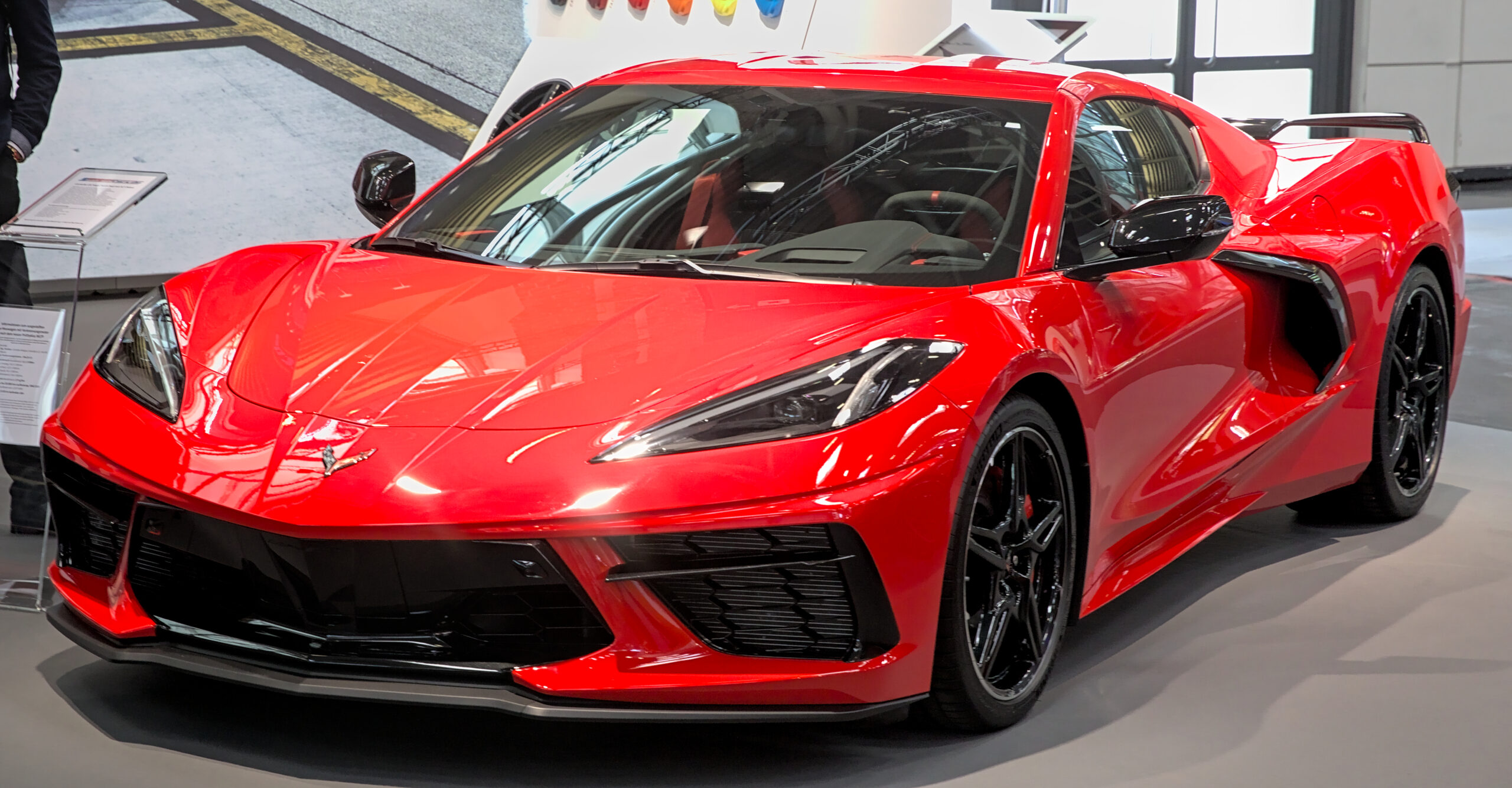
The mid-engine C8 turned the Corvette into a genuine supercar rival at a sports-car price. Here is how to choose between Stingray, Z06, E-Ray, and ZR1 — and what to check before you buy used.
For sixty-seven years, every Corvette carried its engine ahead of the driver. In 2020 Chevrolet moved it behind the seats, and the car changed more in one generation than it had in the previous seven. The C8 is the first production Corvette with a rear mid-engine layout, ending the front-engine configuration that had defined the car since 1953.[1] Six years on, the used market has matured, the variant lineup has filled out, and there are real choices to make. This guide walks through them in order.
What actually changed
Mid-engine placement is not a styling decision. Putting the mass between the axles resets the car’s proportions and its dynamics — better traction under power, quicker rotation, and a driving position pushed toward the front wheels.[1] These are the reasons exotic manufacturers have built cars this way for decades, and the C8 delivers that layout at a fraction of their price. Chevrolet kept the Corvette’s value ethos intact: the base Stingray opened at $60,995 in 2021.[1]
Two body styles are offered — a targa-top coupe with a removable roof panel, and a convertible — and one transmission: the 8-speed Tremec TR-9080 dual-clutch.[1] There is no manual gearbox anywhere in the range. If three pedals are non-negotiable for you, the C8 is not your Corvette, and it is better to know that before you fall for one. For everyone else, the dual-clutch is central to how the car performs.
Start with the Stingray
The base car is where most buyers should begin and where many should end. The Stingray uses a naturally aspirated 6.2-liter LT2 pushrod V8 making 490 hp — 495 hp with the performance exhaust — and 465 lb-ft of torque.[1] Equipped with the Z51 performance package, it reaches 60 mph in roughly 2.9 seconds.[1] Read that number again. The entry-level Corvette runs with cars costing three times as much.
On the used market, seek out Z51 cars. The package is common, it is what gives the Stingray its sharpest edge, and it costs far less to buy than to wish for later. Early build years also carry the desirable one-off editions — Chevrolet marked the model’s anniversary with a 70th Anniversary Edition and built a 1,000-unit IMSA GTLM Championship Edition.[1] These are collectible footnotes rather than performance upgrades; buy them for provenance, not pace.
Z06, E-Ray, and the ZR1s
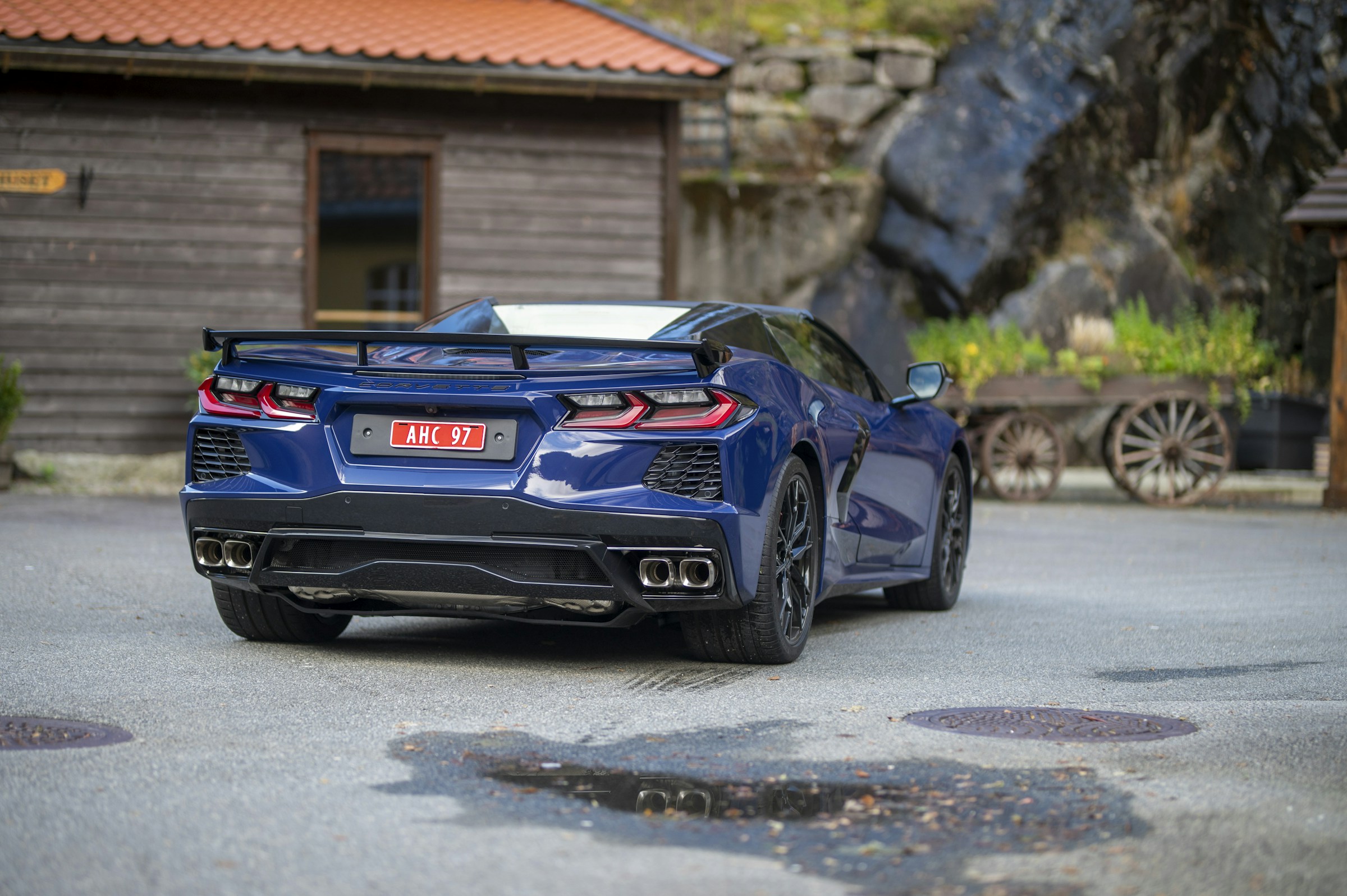
Above the Stingray, the lineup splits into three distinct philosophies.[1]
- Z06 — a 670 hp, 5.5-liter LT6 flat-plane-crank DOHC V8 that revs like a race engine, with a 195 mph top speed. The track special.
- E-Ray — a hybrid that pairs the 6.2-liter LT2 with electric drive for 655 combined hp and all-wheel drive, topping out at 183 mph. The all-weather, all-season C8.
- ZR1 — a 5.5-liter LT7 twin-turbo V8 making 1,064 hp and 828 lb-ft, good for 233 mph and 0–60 in 2.3 seconds. Above it, the hybrid all-wheel-drive ZR1X claims 1,250 hp and a sub-2-second run to 60.
Be honest about which question you are answering. The Z06 rewards track days and short, loud drives; its flat-plane engine is the event. The E-Ray is the one to daily through four seasons. The ZR1 and ZR1X are flagships — extraordinary, rare, and priced accordingly on the secondary market. None of them makes the Stingray feel slow, which is the C8’s quiet trick: the cheapest car in the range is never the compromise it would be elsewhere.
You can compare what is actually for sale right now — browse live Corvette inventory here — or read the full generation history and specs on the Corvette C8 database page.
Living with a C8
For a mid-engine car, the C8 is unusually easy to use. There are two trunks — a frunk under the hood and a rear well behind the engine deep enough for a set of golf clubs — so it works for a weekend away in a way most exotics do not. The removable coupe roof panel stows in the rear trunk, turning the car open-top without committing to the convertible. Magnetic-ride dampers, where fitted, keep the ride genuinely comfortable on rough roads, and the front-lift option — worth seeking out used — raises the nose over driveways and speed bumps that would otherwise scrape it. On a car this low, that option is the difference between driving it daily and wincing every time you leave home.
Running costs sit below the car’s performance bracket, which is much of the point. Insurance and consumables are real but not exotic-car punishing on a Stingray; on a Z06 or ZR1 the tyres and brakes climb steeply, and track use accelerates both. The early market distortion — dealer markups over sticker on the first cars — has largely unwound, so used prices now reflect the car rather than the hype, but it is still worth checking a listing’s history for added-cost dealer packages that inflate the number without adding value.
One more practical note: the C8 has evolved year to year, so shop the model year as carefully as the trim. Later Stingrays gained equipment and running changes over the first 2020 cars, and the higher variants arrived in sequence — the Z06 for 2023, the E-Ray for 2024, the ZR1 after. Match the year to the spec you actually want rather than assuming every C8 of a given trim is identical.
What to check before you buy
The C8 is a modern GM product with a strong reliability reputation, but at these performance levels the car’s history matters more than its badge. Before committing:
- Documentation first. Insist on complete service records, the original window sticker, and a clean title history. A fully documented car is worth meaningfully more than an identical undocumented one, and the gap widens on the higher trims.
- Ask about track use. Track time is not disqualifying — these cars are built for it — but it should be disclosed, and consumables should reflect honest maintenance. Check the age and wear of tires and brakes; on a Z06 or ZR1, a full set of both is a significant line item.
- Verify the options. Z51, magnetic dampers, front-lift — confirm what the car actually has against the build sheet rather than the listing copy.
- Check warranty status. Many C8s are young enough to carry factory coverage. Confirm it transfers, and whether any early markup-era dealer add-ons affect it.
- Budget for a pre-purchase inspection. A PPI by a Corvette-literate shop is the cheapest insurance you will buy, and on a six-figure Z06 or ZR1 it is simply mandatory.
The verdict
For most buyers, a Stingray with the Z51 package is the C8 to own — genuinely fast, usable every day, and the best performance-per-dollar in the range. Choose the E-Ray if you want one car for all seasons, the Z06 if track days are a real part of your plans, and a ZR1 only if you are buying a flagship on purpose. Whichever you choose, the rule from the top of the market applies all the way down: buy the best-documented example you can find, not the cheapest one you can reach.
Sources
- Chevrolet, Corvette official model lineup, chevrolet.com. Tier 1
- Car and Driver, Chevrolet Corvette model overview and reviews, caranddriver.com/chevrolet/corvette.
- National Corvette Restorers Society, documentation and judging resources, ncrs.org.