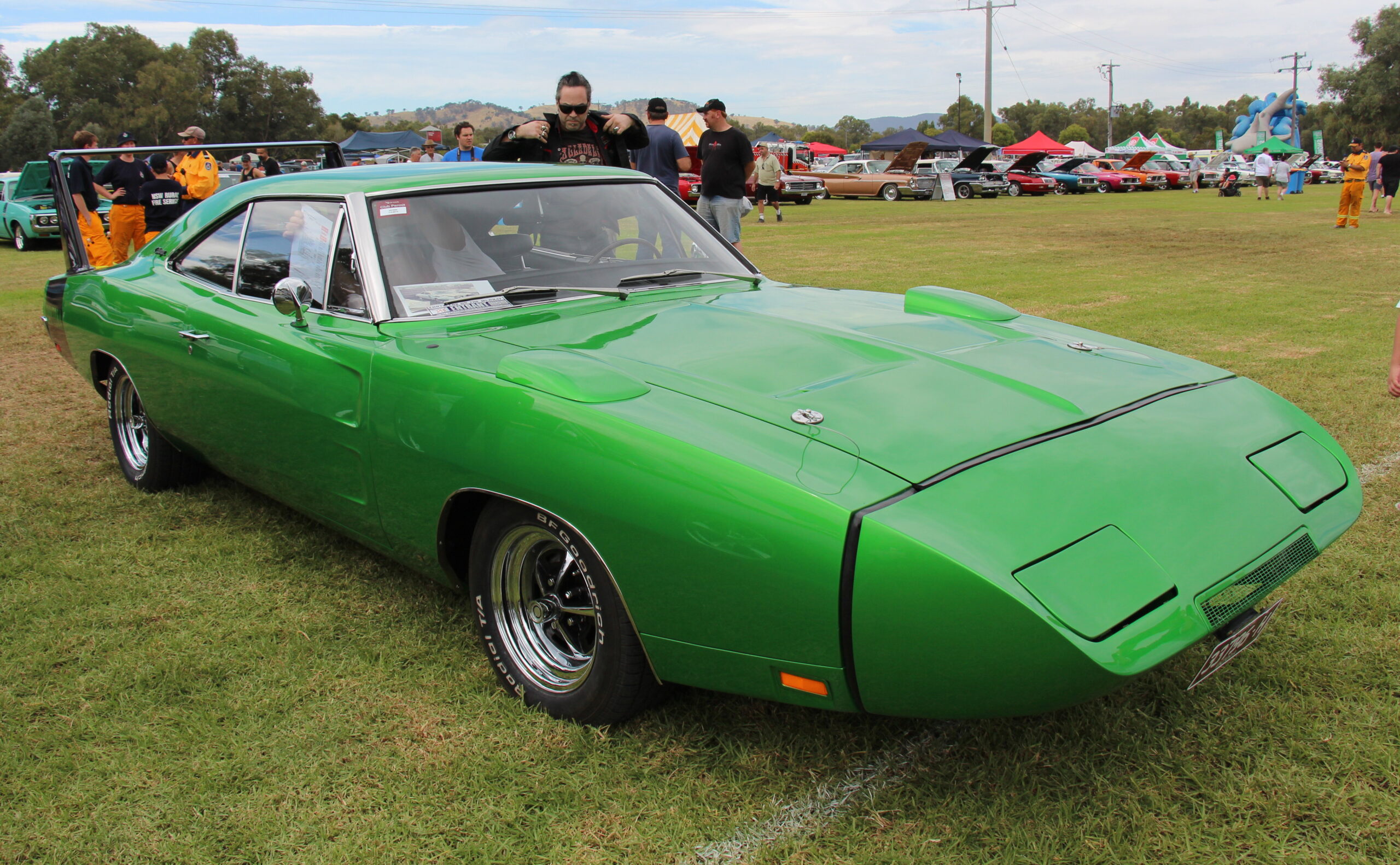
How a NASCAR homologation special with a 23-inch wing became the name Dodge chose for its electric muscle car. The Charger Daytona, era by era.
The Dodge Charger Daytona exists because of a racing problem. In 1969, Dodge needed an answer to Ford on NASCAR’s high-speed ovals, so it built an aero-warrior version of the Charger with a pointed nose cone and a towering 23-inch rear wing.[1] Racing rules required road cars, so Dodge built just 503 of them, 70 fitted with the 426 Hemi V8.[1] That is the entire origin story: a street car that exists so a race car could.
What the wing bought
The aerodynamic package proved decisive. On March 24, 1970, Buddy Baker became the first NASCAR driver to break the 200 mph barrier, doing it in a Charger Daytona.[1] The car won six races before NASCAR rule changes effectively banned the aero specials after the 1970 season.[1] A one-year run, a landmark speed record, and a ban: few cars have a resume that clean.
The name returns
Dodge revived the Daytona name on the modern LX-platform Charger, including a 2013 edition with a 370-hp Hemi V8 limited to 3,000 units, and special high-output versions offered through 2023 with 5.7- and 6.4-liter V8 engines.[1] These were appearance-and-performance packages that kept the badge alive, trading on the 1969 car’s legend rather than chasing new records.
The electric era
The current Charger Daytona is the boldest use of the name yet. Power comes from dual permanent magnet synchronous electric motors driving all four wheels through a single-speed transmission, wrapped in a two- or four-door liftback body.[1] The R/T version makes 496 hp and 404 lb-ft of torque, while the Scat Pack delivers 670 hp and 627 lb-ft.[1] At launch for 2024, the R/T carried an MSRP of $59,595 and the Scat Pack $73,190.[1] Dodge has even developed a Fratzonic Chambered exhaust concept to give the electric car a voice.[1]
The through-line is intent. In 1969 the Daytona badge meant Dodge was willing to build something extreme to win. Applying it to the brand’s electric muscle car is a statement that the same willingness applies now. Whether the market treats the electric Daytona as a worthy heir is a question collectors will settle over time.
Full specifications, variants, and history live on the Dodge Charger Daytona database page. When you are ready to see real cars, browse the current Charger Daytona inventory.
Sources
- Dodge, Charger official model page, dodge.com. Tier 1
- Car and Driver, Dodge Charger Daytona model overview, reviews, and specifications, caranddriver.com/dodge/charger-daytona.