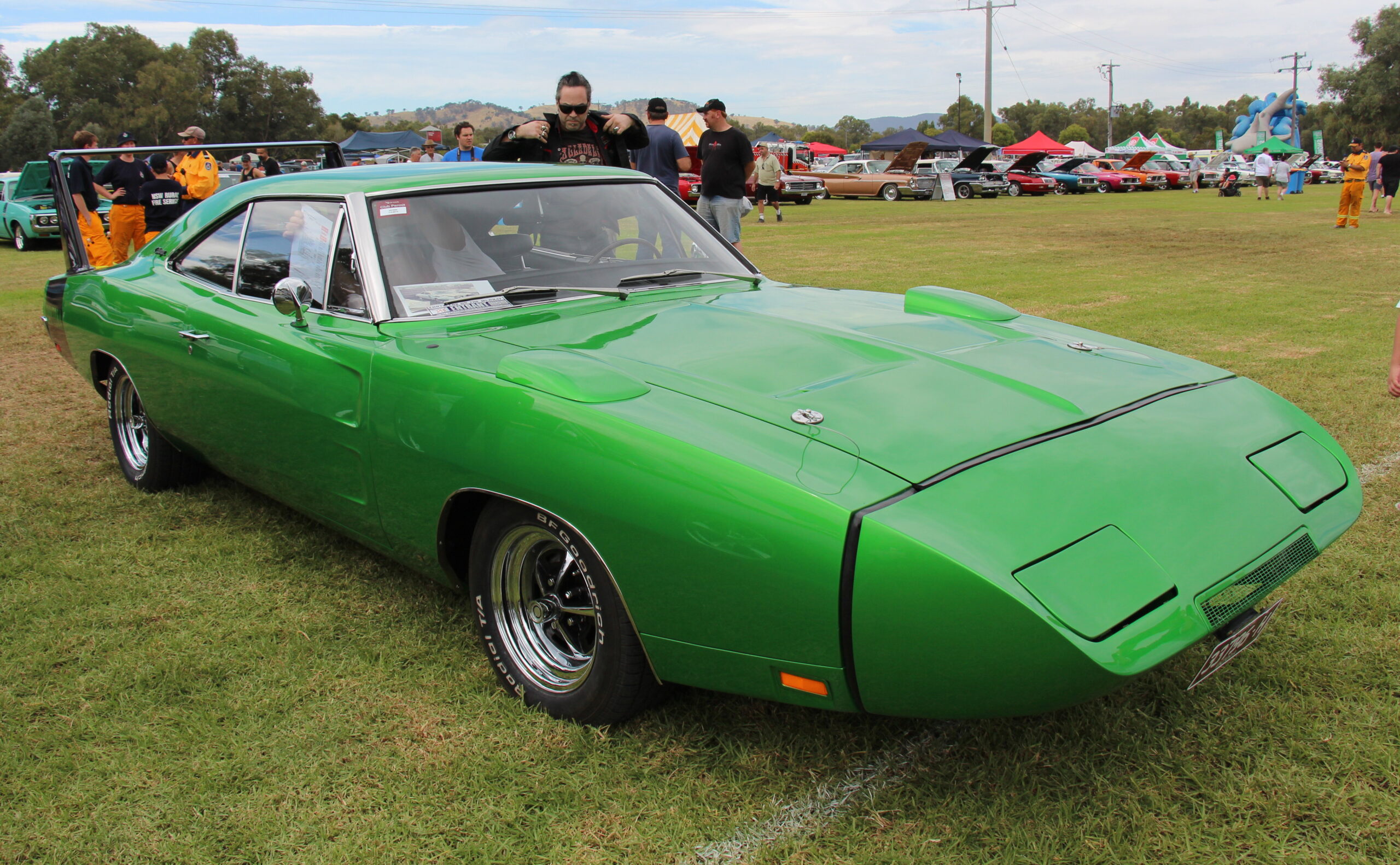
The Charger Daytona name covers everything from a 1969 NASCAR homologation special to today's electric muscle car. Here's how to shop each one with clear eyes.
Few nameplates ask a buyer to make a bigger decision up front than Charger Daytona. The badge belongs to a 1969 aerodynamic homologation special, a run of modern V8 tribute editions, and now an all-electric muscle car.[1] Before you look at a single listing, decide which of these cars you are actually buying, because the money, the checks, and the ownership experience are entirely different.
The original wing car
The 1969 Daytona was built so Dodge could race its pointed nose cone and 23-inch rear wing in NASCAR. Just 503 road cars were produced to homologate the package, and only 70 of them carried the 426 Hemi V8.[1] The aero body did its job: Buddy Baker became the first NASCAR driver to break 200 mph in a Charger Daytona on March 24, 1970, and the car won six races before rule changes ended the aero era.[1] With numbers that small, provenance is everything. Insist on a documented history, matching numbers, and an inspection by a marque specialist before any funds move. A car this rare deserves a paper trail as long as its wing is tall.
The modern Daytona
Dodge has also used the name on later Chargers, including a 2013 edition with a 370-hp Hemi V8 limited to 3,000 units, and high-output V8 versions offered through 2023.[1] The current car changes the formula completely: dual permanent magnet synchronous electric motors, a single-speed transmission, and all-wheel drive in a two- or four-door liftback body.[1] The R/T produces 496 hp and 404 lb-ft of torque; the Scat Pack raises that to 670 hp and 627 lb-ft.[1] For 2024, MSRP was $59,595 for the R/T and $73,190 for the Scat Pack.[1]
Before you commit
Whichever era you settle on, the fundamentals hold:
- Documentation first. Service records, title history, and for the 1969 cars, every scrap of provenance you can find.
- Pre-purchase inspection. For a classic, use a specialist; for the electric car, have a franchised dealer confirm software status and battery health.
- Buy the seller, not just the car. A transparent seller with organized paperwork is worth paying for.
Start with the spec detail on the full Dodge Charger Daytona database page, then see what the market is offering right now in our live Charger Daytona listings. The right car is the one whose story checks out.
Sources
- Dodge, Charger official model page, dodge.com. Tier 1
- Car and Driver, Dodge Charger Daytona model overview, reviews, and specifications, caranddriver.com/dodge/charger-daytona.